The Hidden Variable: Lamination Quality vs. Membrane Specs
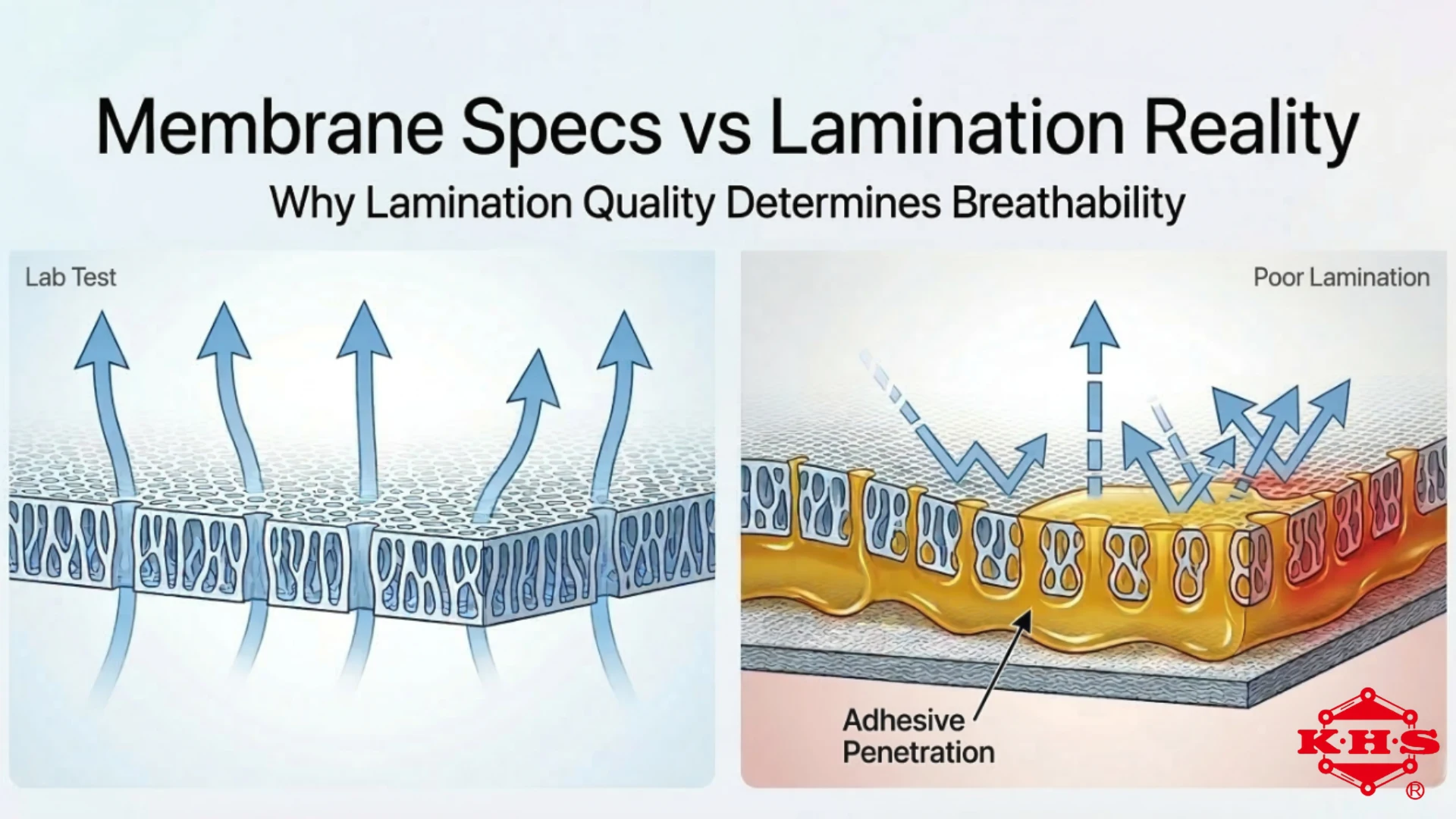
Procurement teams, product designers, and material engineers often base their crucial purchasing decisions on the standalone specifications of breathable films, yet they frequently overlook a critical manufacturing variable that dictates real-world performance: lamination quality. Applying conventional adhesives through outdated offline processes can significantly reduce the effective pore surface area, causing a microporous membrane with an exceptionally high nominal Moisture Vapor Transmission Rate (MVTR) to suffer a significant reduction in effective MVTR once integrated into a final garment or protective suit. Furthermore, offline lamination processes can introduce severe thermal stress and uneven mechanical tension, degrading the hydrostatic resistance and structural integrity of the composite fabric. Advanced in-line lamination addresses this fundamental flaw by bonding the freshly cast membrane directly to the substrate in a single, continuous step without the need for reheating or intermediate storage. This seamless integration not only preserves the engineered breathability and improves dimensional stability, but it also significantly reduces energy consumption and production costs, demonstrating that assembly precision is just as critical as polymer chemistry in delivering high-performance waterproof breathable textiles.
The Hidden Variable: Lamination Quality vs. Membrane Specs
When sourcing waterproof breathable laminates for medical PPE, outdoor performance wear, or industrial protective clothing, B2B buyers meticulously scrutinize data sheets. Metrics like Moisture Vapor Transmission Rate (MVTR) and hydrostatic head pressure are heavily weighted. However, evaluating a membrane in isolation provides an incomplete picture. The true determinant of a functional textile's field performance lies in the assembly process—specifically, the lamination quality.
The MVTR Illusion: Why Standalone Specifications Can Mislead

Specify a microporous or monolithic film with an exceptionally high MVTR, and you naturally expect outstanding breathability in the final product. However, the reality of textile manufacturing often tells a different story. The transition from a raw membrane to a durable, multi-layer composite requires bonding, and this is where the "MVTR Illusion" occurs.
The application of conventional, heavy adhesives to bond the film to a woven or nonwoven substrate can significantly reduce the effective pore surface area. When glue physically obstructs the microscopic pathways designed for moisture vapor to escape, the breathability of the finished garment plummets, regardless of how impressive the raw film's test results (such as ASTM E96 or JIS L1099) appeared on paper. However, these standardized tests evaluate standalone membranes under controlled laboratory conditions.
For B2B manufacturers, this leads to a critical disconnect: paying a premium for a top-tier breathable waterproof film, only to deliver a final product that leaves the end-user trapped in accumulated moisture and discomfort. The finished composite's performance is the only metric that translates to the end-user, making the lamination technique a make-or-break factor in product development.
Process Engineering: The Kae Hwa In-Line Lamination Advantage
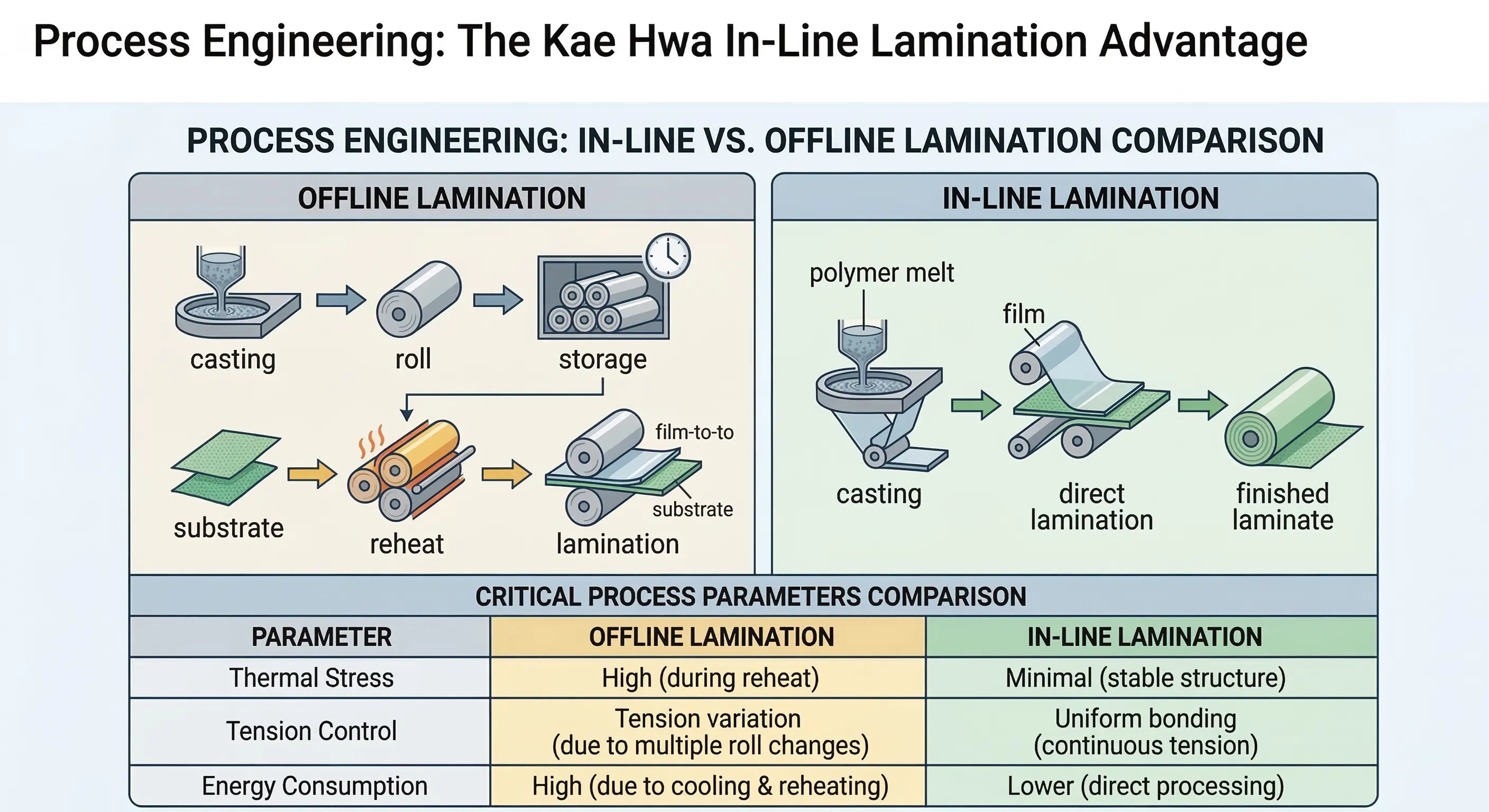
To solve the industry-wide challenge of compromised breathability and degraded hydrostatic resistance, process engineering must evolve. Kae Hwa Industrial Co., Ltd. addresses this directly by enhancing its casting process with advanced in-line lamination technology.
Traditional offline lamination requires the cast film to be rolled, stored, and later unwound and reheated to be bonded with a substrate. In contrast, Kae Hwa's in-line lamination enables immediate bonding right after the film is formed. This integrated system allows the freshly cast membrane to be laminated directly with nonwovens or fabrics without additional rewinding or reheating.
By bypassing the disruptive stages of cooling, storing, and reheating, the polymer maintains its optimal state during bonding. This real-time lamination approach reduces handling time, eliminates intermediate storage, and ensures consistent quality from film to the final fabric.
Manufacturing Insight: Eliminating Thermal Stress and Mechanical Tension
The Engineer's View: Why Offline Processing Fails High-Performance Films
From a manufacturing and polymer science perspective, repeatedly subjecting thin-film membranes (which can be as thin as a few microns) to thermal and mechanical cycles is inherently risky. Offline lamination processes introduce significant thermal stress when the film is reheated to accept adhesives. Coupled with uneven mechanical tension during the unwinding and rewinding phases, the membrane can suffer from micro-tears or unnatural stretching. This stretching distorts the carefully engineered microporous structure, leading to compromised hydrostatic resistance (waterproofing failure) and inconsistent breathability.
Rather than relying on disjointed assembly stages, Kae Hwa's casting film technology utilizes strict process controls and continuous temperature calibration. This precise manufacturing environment allows us to achieve consistent film formation within a ±0.01 mm thickness tolerance—an essential baseline for advanced downstream lamination. Because the in-line bonding occurs immediately, the physical integrity and uniform pore structure of the film are locked in place before environmental or mechanical stressors can warp them. The result is stronger adhesion and significantly improved dimensional stability, ensuring the material maintains its form under pressure or temperature variation.
Overcoming B2B Pain Points: Cost, Durability, and Compliance
For procurement directors and production managers, supply chain reliability and cost-efficiency are paramount. Poor lamination doesn't just hurt product performance; it causes high defect rates, increased scrap, and customer returns.
By implementing in-line lamination, Kae Hwa effectively solves these primary B2B pain points:
- Enhanced Durability: The process delivers enhanced lamination strength and uniformity, preventing delamination during harsh end-use conditions or rigorous industrial washing.
- Cost and Efficiency: The continuous nature of the line results in a shorter production cycle and higher productivity. Furthermore, it yields significantly lower production costs and energy use.
- Regulatory Compliance: Global brands demand stringent quality control. Kae Hwa's facilities operate under ISO 9001 and ISO 14001 certified systems, supporting compliance with relevant international standards such as CE, AAMI, ASTM, and EN, depending on final product configuration.
Preserving Specifications Through Sustainability
Modern manufacturing is no longer just about performance; it is inextricably linked to environmental responsibility. Conventional lamination often relies on solvent-based adhesives that emit Volatile Organic Compounds (VOCs), posing risks to both workers and the environment.
Kae Hwa's commitment to sustainability is embedded in its manufacturing DNA. The in-line bonding process is a solvent-free lamination method. This translates to a cleaner production environment and a safer product for end-users, whether they are wearing medical gowns, outdoor jackets (like the ProShell™ series), or utilizing agricultural covers (like AgriGuard™).
Furthermore, the technology allows for a recyclable composite design. Supported by GRS (Global Recycle Standard) certification and ISO 14064-1 carbon verification, Kae Hwa ensures that brands can achieve high performance without compromising their ESG (Environmental, Social, and Governance) commitments.
Partner with Manufacturing Excellence
Do not let outdated lamination processes silently destroy the specifications of your premium materials. True performance is born at the intersection of advanced polymer science and flawless manufacturing execution.
Partner with Kae Hwa to leverage state-of-the-art casting and in-line lamination technologies. Ensure your next line of functional apparel, medical protection, or industrial covers delivers the exact waterproof and breathable performance you promised your customers. Contact our engineering and sales team today to request material samples and discuss your custom lamination requirements.
FAQ
Q: How does in-line lamination differ from traditional offline lamination?
A: Traditional offline lamination requires cast films to be rolled, stored, unwound, and reheated before bonding, which can introduce thermal stress and mechanical tension. In-line lamination bonds the freshly cast membrane directly to the substrate in a single, continuous step without rewinding or reheating, preserving the film's structural integrity.
Q: Why does my high-MVTR fabric feel unbreathable in the final product?
A: This is often due to the "MVTR Illusion." If heavy or inappropriate adhesives are used during a poorly controlled lamination process, the adhesive can physically block the micropores of the membrane, drastically reducing the effective vapor transmission rate of the finished composite fabric.
Q: Is Kae Hwa's in-line lamination process environmentally friendly?
A: Yes. The in-line bonding method utilizes a solvent-free process, which eliminates harmful VOC emissions typically associated with traditional adhesives. Additionally, the process reduces overall energy consumption and supports the creation of recyclable composite designs.
Q: What industries benefit most from Kae Hwa's lamination technology?
A: Our advanced waterproof and breathable laminates are trusted by global brands across multiple sectors, including medical and hygiene (diaper backsheets, protective coveralls), outdoor performance apparel (skiing and mountaineering jackets), construction (roofing underlayments), and agriculture.